Best Mobile Coffee Truck Grinders for Quiet, Compact Setups
By Omar Farouk • 2nd Jun
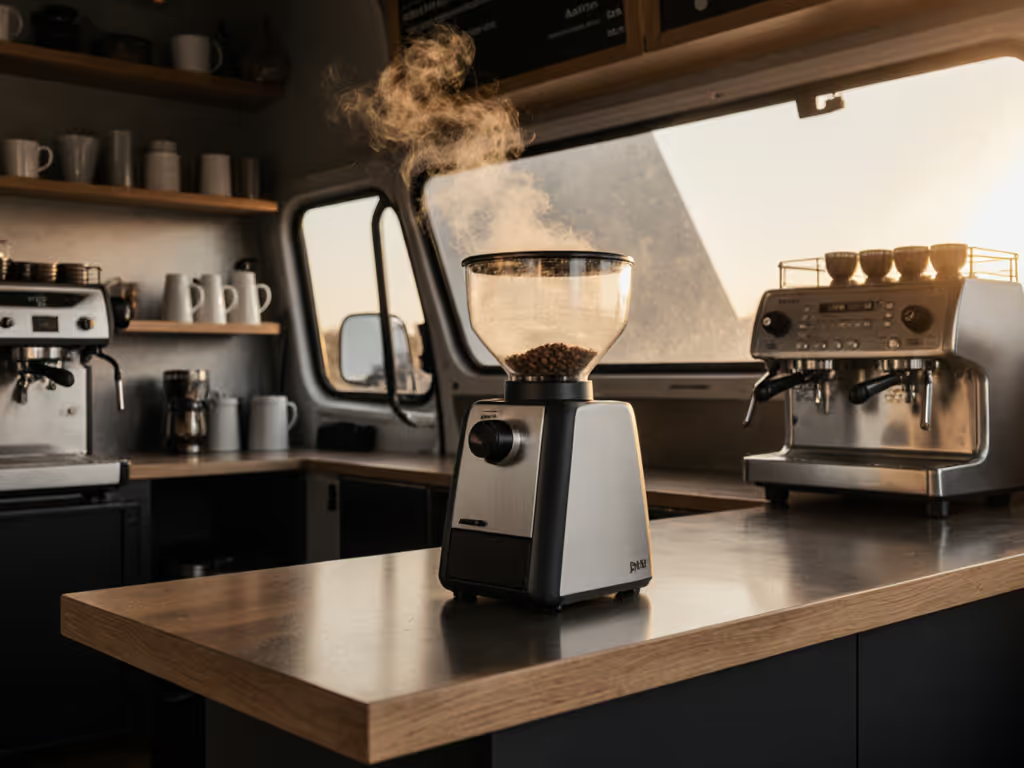
Running a coffee truck means your mobile coffee truck grinders sit inches from your customers, your staff, and your own ears. The right pop-up cafe grinding equipment has to be quiet, compact, reliable, and fast enough to keep a line moving, without turning your truck into a jet engine.
This guide walks you step-by-step from requirements to specific grinder archetypes, then shows you how to dial them in with simple, repeatable habits you can trust in a small, noisy, moving space.
Start simple: define your constraints, narrow to 2-3 grinder candidates, and then test with a small, controlled routine.
--
How to Use This Guide
We'll follow a clear path:
- Clarify your truck's reality: space, power, volume, and noise tolerance.
- Turn that into grinder specs: noise in dB, footprint, retention, dosing style.
- Demystify the tech in plain language: burrs, motors, cooling, workflow.
- Review 4 grinder archetypes that fit mobile setups, with pros and trade-offs.
- Build a simple comparison sheet so you can choose confidently.
- Dial in and maintain your grinder for consistent service.
Throughout, we'll link technical metrics (noise, retention, burr size) to what you actually taste in the cup and how smoothly your shift runs.
--
Step 1: Map Your Mobile Setup Before You Shop
Before looking at quiet coffee grinder specs, write down your truck's constraints. This saves you from buying the wrong commercial grinder just because it looked "pro" in a cafe.
1.1 Power and Voltage
Micro-goal: know exactly what your grinder can draw without tripping anything.
- Power source: generator, shore power, battery system, or hybrid.
- Available wattage on the grinder circuit: ask your electrician or review your panel.
- Voltage: many commercial grinders come in both 110-120 V and 220-240 V versions. If you operate internationally, read our 220V vs 110V guide before choosing a model.
Cause-to-effect: if your grinder draws too much, your voltage sags, which slows the motor, increases grind time, and can subtly change your grind consistency mid-rush.
1.2 Noise Tolerance
Noise is not just comfort, it's part of your brand.
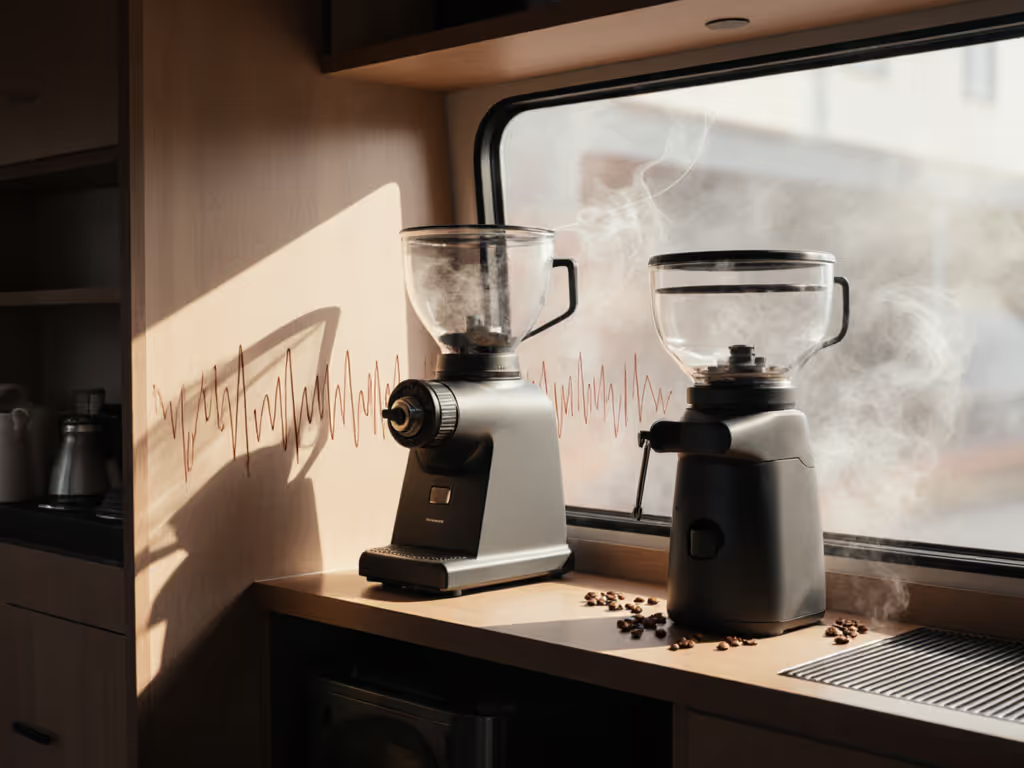
For a compact mobile coffee setup, realistic grinder noise targets are: See dB measurements in our quiet grinder dB comparison to benchmark models for truck environments.
- Under 70 dB at 1 meter: perceived as "quiet-ish conversation level."
- 70-75 dB: very common in commercial grinders, usually acceptable outdoors.
- 75-80+ dB: starts to feel harsh in a truck, especially early mornings.
If you're in residential streets at 7 a.m., bias toward insulated, "silent" grinders even if they're slightly slower.
1.3 Menu and Volume
Clarify what your grinder has to handle.
- Menu profile:
- Espresso only
- Espresso + milk drinks only
- Espresso + milk + batch brew
- Espresso + filter by-the-cup
- Daily drink volume: roughly how many drinks per day and peak drinks per hour.
For high-volume espresso (200+ drinks/day), you may want one grinder just for espresso and a separate electric coffee grinder for batch/filter.
1.4 Space and Workflow
Measure the actual usable area, not just "that corner seems free."
- Width, depth, and height to the lowest shelf or ceiling panel.
- Clearance in front for portafilter or cup movement.
- Clearance above for hopper and cleaning.
Cause-to-effect: a grinder that's 3-4 cm too tall forces awkward angles and spills, which slows your barista and increases waste.
Write these numbers down. They will filter out 50% of options immediately.
--
Step 2: Turn Constraints Into Concrete Grinder Requirements
Now we translate your reality into a clear spec sheet for mobile coffee truck grinders.
2.1 Noise: What "Quiet" Should Mean for You
Think in scenarios, not just dB numbers:
-
Quiet priority (residential / early morning)
-
Aim for grinders marketed as "silent" with heavy sound insulation.
-
Target: around 65-70 dB at 1 meter during grinding.
-
Expect: slightly slower grind speeds, but calmer atmosphere.
-
Moderate priority (busy streets / markets)
-
70-75 dB is usually fine; focus more on speed and robustness.
If possible, test or watch video comparisons of grind noise in a small room (not a huge cafe) to approximate truck conditions.
2.2 Footprint and Weight
For a compact mobile coffee setup, aim for:
- Width: under 20-22 cm if you're tight.
- Depth: under 25-30 cm so it doesn't block walkways.
- Height: check the total, including hopper.
Heavier grinders (10-15+ kg) are more stable against truck vibration but harder to move. If you reposition the grinder daily, consider something in the 7-10 kg range with a stable base and anti-slip mat.
2.3 Dosing Style: Hopper vs Single-Dose
For trucks, dosing affects consistency, waste, and speed. For a full workflow breakdown, see single-dose vs hopper grinders.
-
Hopper-fed grinder
-
Pros: faster workflow; easy during rush.
-
Cons: beans sitting in hopper can stale, especially in heat.
-
Best for: high-volume espresso where you move through a bag fast.
-
Single-dose grinder
-
Pros: low retention, very fresh; easy to switch coffees; low waste.
-
Cons: extra step per shot; may slow down if workflow isn't tight.
-
Best for: premium, lower-volume trucks, guest coffees, or filter.
In many trucks, a hybrid makes sense: a hopper grinder for house espresso + a single-dose grinder for decaf or filter.
2.4 Retention and Exchange
Retention is how much coffee stays inside the grinder between uses.
- Under 0.3-0.5 g: excellent for single dosing, minimal waste.
- 1-2 g: common for hopper grinders; fine for high turnover espresso.
Cause-to-effect:
- High retention = more old coffee in the next shot = muted, stale-tasting drinks.
- Low retention = more responsive to grind changes, more clarity in the cup.
For trucks operating in heat, low retention gives you a clearer, fresher taste profile over a long shift.
--
Step 3: Grinder Tech, De-Jargonized
You do not need a PhD in burr geometry. You just need to know which features change taste and workflow.
3.1 Burr Size
-
55-65 mm burrs
-
Good balance of speed, temperature control, and compactness.
-
Common in many quiet commercial grinders.
-
65-83 mm burrs
-
Faster, can offer more clarity and consistency.
-
Often taller and heavier; check your ceiling height.
In a truck, 60-65 mm is a practical sweet spot for many menus.
3.2 Burr Shape: Flat vs Conical
Simple version:
-
Flat burrs
-
Often give more clarity and separation of flavors.
-
Common in cafe and truck setups.
-
Conical burrs
-
Often give more body and "roundness."
-
Sometimes more forgiving with slight dialing mistakes.
Either can be excellent. For workflow, focus more on adjustment precision, noise, and reliability than shape alone.
3.3 Adjustment Mechanism
You want fast, repeatable dialing under pressure. If you're choosing between mechanisms, our stepped vs stepless guide explains precision and repeatability trade-offs.
- Stepless: infinite adjustment; great for fine-tuning espresso, but you must mark your own reference points.
- Stepped: click-style; easier to repeat settings, but sometimes the step is too big for perfect espresso tuning.
For mixed menus (espresso + filter), stepless with clear markings works well, as long as you develop a simple note-taking habit.
Change one variable, taste twice, write it down.
--
Step 4: Four Grinder Archetypes That Work in Trucks
We'll review four commercial grinder archetypes (with typical examples) that fit real-world truck constraints. Use this as a mental model when comparing specific models.
4.1 Quiet Flat-Burr Workhorse for Espresso-Heavy Trucks
Profile: 65 mm flat-burr grinder, sound-insulated body, hopper-fed, stepless.
Why it works for trucks
- Designed for lower noise: insulated case, anti-vibration feet.
- Compact footprint: often around 20 cm wide.
- Stepless adjustment lets you fine-tune shots as your truck warms up.
Strengths
- Noise: often 65-70 dB range, friendly for residential mornings.
- Speed: roughly 3-5 s for an 18 g espresso dose.
- Taste: clear, balanced shots with enough body for milk drinks.
Trade-offs
- Typically hopper-only: not ideal if you change coffees constantly.
- More expensive than entry-level options, but much more stable long-term.
Best for: espresso-focused trucks doing 150-300 drinks/day, especially with early morning routes.
4.2 Compact, Durable Hopper Grinder for Mixed Menus
Profile: 60-64 mm flat-burr grinder, modest sound control, compact, durable build.
Why it works for trucks
- Balance of cost, speed, and reliability.
- Enough adjustability for espresso; coarse settings possible for batch brew.
- Simple electronics and sturdy parts handle vibration and transport well.
Strengths
- Footprint: often one of the smallest true commercial grinders.
- Durability: metal body, long-lasting burrs, serviceable motors.
- Cost: mid-range; good value for first truck.
Trade-offs
- Noise typically 70-75 dB, fine for markets, a bit loud for quiet streets.
- Not the lowest retention; better for house espresso than frequent coffee switches.
Best for: first trucks launching on a budget, mixed urban routes, where durability and value outrank ultra-low noise.
4.3 Single-Dose Flat Burr for Premium, Low-Retention Service
Profile: High-precision 64 mm or 80 mm flat-burr single-dose grinder, stepless, very low retention.
Why it works for trucks
- Low retention (often under 0.3 g): perfect for rotating single-origin espresso or filter.
- Very clear cup profile; easier to showcase distinct coffees.
- Flexible: can switch between espresso and filter without purging grams of coffee.
Strengths
- Taste: increased clarity and sweetness versus many mid-tier grinders.
- Waste: minimal; great when beans are expensive.
- Workflow: easy to experiment with different coffees in the off-peak hours.
Trade-offs
- Single-dosing can be slower if your workflow isn't dialed in.
- Some models can be louder (thin metal bodies) despite smaller size.
- Higher upfront cost; more of an "investment piece."
Best for: trucks focusing on specialty espresso and pour-over, lower-to-medium volume, and storytelling around coffee quality.
4.4 Budget-Friendly Compact Grinder for Test or Secondary Use
Profile: Smaller 50-55 mm burr grinder, often marketed for prosumer/home, but robust enough for light commercial use.
Why it works for trucks
- Very compact footprint; easy to fit into tight layouts.
- Often surprisingly quiet due to smaller motors and added insulation.
- Good candidate as a dedicated decaf or guest espresso grinder.
Strengths
- Noise: can be among the quietest options you'll own.
- Cost: friendly for first-time operators or backup roles.
- Flexibility: often easier to switch between brew methods.
Trade-offs
- Slower grind time, especially at finer settings.
- Not ideal as the only grinder for heavy service; better as a second unit.
Best for: secondary roles in established trucks, or as the main grinder in lower-volume, test-market trucks.
--
Step 5: Compare Grinders with a Simple Scoring Sheet
Instead of trying to remember every spec, build a one-page comparison. Keep it simple so you can update it after real-world testing.
5.1 Core Metrics to Score (1-5)
- Noise (1 = too loud, 5 = comfortable in a truck)
- Speed (1 = slow, 5 = keeps up with rush)
- Footprint & fit (1 = awkward, 5 = perfect fit)
- Retention (1 = wasteful, 5 = very low)
- Adjustment ease (1 = confusing, 5 = intuitive)
- Cleaning & maintenance (1 = painful, 5 = easy)
- Taste for your menu (1 = flat, 5 = "wow" in the cup)
5.2 Example Comparison Table (Archetypes)
| Metric | Quiet Workhorse | Compact Hopper | Single-Dose Premium | Budget Compact |
|---|---|---|---|---|
| Noise | 5 | 3 | 3-4 | 4-5 |
| Speed | 4 | 4 | 3-4 | 2-3 |
| Footprint & Fit | 4 | 5 | 4 | 5 |
| Retention | 3 | 2-3 | 5 | 3-4 |
| Adjustment Ease | 4 | 3-4 | 4-5 | 3-4 |
| Cleaning & Maintenance | 4 | 4 | 3-4 | 3-4 |
| Taste for Your Menu | 4 | 3-4 | 5 | 3 |
Use this as a template. Replace the column labels with actual grinder names and fill in scores based on specs and any hands-on testing you can do.
Don't chase perfect scores. Choose the grinder whose strengths match your truck's realities.
--
Step 6: Set Up and Dial In for Consistent Mobile Service
Once your grinder arrives, the real work is building a repeatable routine.
6.1 Initial Setup Checklist
Micro-goal: get to a first tasty shot or brew within 1-2 attempts.
- Stabilize the grinder
- Place it on a non-slip mat.
- Check it's level; shims or coasters can help.
- Check calibration
- With the grinder off and unplugged, bring the burrs slowly together to find "zero."
- Back off to your recommended starting point for espresso.
- Record your starting points
- Note the grind setting for:
- House espresso
- Decaf espresso (if applicable)
- Filter/batch brew (if your grinder will handle both)
- Set your dosing
- If timed dosing: set to hit your target dose (e.g., 18 g) and test across at least 5 shots.
- If single dosing: check the scale reading in and out to confirm retention.
6.2 Dialing In Espresso for a Truck Environment
Use one house espresso recipe as your anchor.
- Starting point (example): 18 g in, 36 g out, 25-30 s.
- Pull a shot; taste.
- Sour, thin, fast? Grind finer.
- Bitter, harsh, slow? Grind coarser.
Make one change at a time and keep notes:
- Change grind by a small, consistent step.
- Pull two shots to confirm the change.
- Write down: date, grind mark, dose, yield, time, quick taste note.
Change one variable, taste twice, write it down.
This matters more in a truck, where temperature and humidity swing across a shift. Your notes help you adjust quickly when conditions change.
6.3 Dialing In for Batch Brew or Filter
If your grinder handles both espresso and filter:
- Find your filter baseline (e.g., 60 g/L, medium grind).
- Brew a batch; taste.
- Adjust grind for clarity and sweetness.
Then record the difference between espresso and filter settings:
- Example: filter is "3 full turns coarser than espresso" on your collar.
- Use tape or a marker to draw reference lines directly on the grinder body.
This lets you switch between espresso and filter quickly without losing your baseline.
--
Step 7: Maintenance and Truck-Specific Care
Trucks are harsher environments than cafes. Vibration, dust, and heat all attack your grinder.
7.1 Daily Routine (End of Shift)
- Brush out the chute and burr chamber lightly.
- Run a small purge (a few grams) if you're using a hopper.
- Wipe exterior surfaces to remove oils and any sticky grounds.
This keeps retention more stable from day to day and reduces off-flavors. For step-by-step instructions, use our grinder cleaning guide.
7.2 Weekly Deep Clean
- Remove hopper (if present) and wash with mild detergent; dry thoroughly.
- Remove upper burr carrier and vacuum or brush the burrs.
- Check for loose screws or any play in the burr carrier, vibration can slowly loosen things.
7.3 Protecting Against Vibration and Heat
- Use dense rubber mats under heavy grinders.
- Avoid mounting grinders directly over engine compartments or hot equipment.
- Ensure some airflow around the motor; don't box it into a tight, sealed cubby.
Cause-to-effect: excess heat reduces motor life and can subtly warm beans, changing shot behavior across the day.
7.4 Burr Replacement and Long-Term Costs
Plan for burr replacements in your cost of ownership:
- Many commercial burrs last 300-800 kg of coffee depending on material and use.
- For a truck pulling 150 drinks/day at ~20 g per drink, you might hit burr replacement every 1-3 years.
Budget for this upfront so burr changes feel like scheduled maintenance, not surprises.
--
Actionable Next Steps: From Idea to Grinder in 3 Short Sessions
To avoid analysis paralysis, break your decision into three focused sessions.
Session 1 (20-30 minutes): Define Your Constraints
- Write down:
- Power, voltage, and available wattage for grinders.
- Exact space for each grinder (width, depth, height).
- Daily volume and busiest hour.
- Noise tolerance (where you park, how early you serve).
- Decide: one grinder or two (espresso + filter/decaf).
Session 2 (30-40 minutes): Shortlist 3-5 Candidates
- Map each candidate to an archetype:
- Quiet flat-burr workhorse
- Compact durable hopper
- Single-dose premium
- Budget compact
- Fill out a scoring sheet for each using the metrics table above.
- Eliminate any grinder that clearly fails on space, noise, or power.
Session 3 (30-60 minutes): Make the Decision and Plan Dial-In
- Choose the grinder that best matches your specific truck reality, not someone else's cafe.
- Draft your dial-in plan:
- Baseline espresso recipe.
- Baseline filter/batch recipe (if applicable).
- A simple log sheet for grind changes and notes.
Your goal is not a "perfect" grinder on paper, but a grinder you can run calmly and consistently in a small, moving, sometimes chaotic space.
If you start simple, document your settings, and keep your changes controlled, you'll find that your grinder becomes the most predictable part of your mobile bar, freeing you to focus on what your customers actually remember: great-tasting drinks and a relaxed, confident service.
Related Articles