Integrated vs Separate Scale: Which Wins for Precision Brewing?
By Omar Farouk • 29th Nov
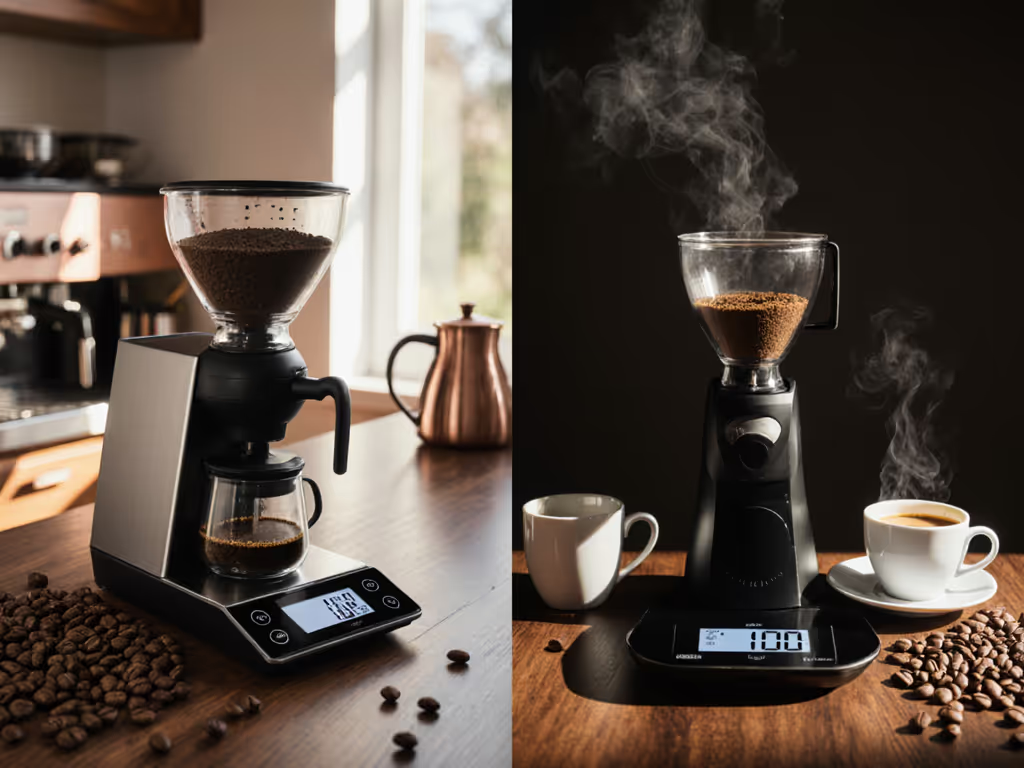
Let’s cut through the noise: the real question isn't whether you need precision coffee measurement, it's how you integrate it into your workflow without friction. When weighing integrated scale vs separate scale options, built-in scale accuracy often gets oversimplified. But your choice hinges on a deeper truth: tools should serve your ritual, not complicate it. As a community educator who's seen countless brewers struggle with analysis paralysis, I'll show you how to match scale strategy to your method-first fit.
Remember my cousin's pour-over breakthrough? We taped a card to her grinder: change one variable, taste twice, write it down. That same principle applies here. Today's comparison isn't about declaring a universal winner (it's about identifying which approach eliminates your biggest brewing frustrations). Let's solve this step by step.
Why Precision Brewing Demands More Than Guesswork
How small variances derail your cup (and why scales fix it)
That 0.5g difference in coffee grounds? It's not academic, it's the gap between balanced sweetness and harsh bitterness. Precision coffee measurement matters because extraction is exponentially sensitive to ratios. A recent industry report confirms: pour-over methods see a 12-15% flavor shift with just ±0.7g variance in dose. Scales transform guesswork into repeatable science by standardizing two critical variables:
- Coffee-to-water ratios (e.g., 1:16 for V60)
- Extraction timing (e.g., 2:30 total brew time)
Without this data, you're troubleshooting blind. Did your espresso sour because of grind size, dose, or pour technique? Scales isolate variables so you can prove what works.
Integrated vs Separate: Defining the Core Trade-Offs
| Feature | Integrated Scale (e.g., grinder with built-in scale) | Separate Scale (dedicated device) |
|---|---|---|
| Setup Speed | ⚡ Instant tare (no transferring grounds) | ⏱️ Requires transferring grounds |
| Space Efficiency | ✅ All-in-one footprint (critical for small kitchens) | ❌ Needs counter real estate |
| Workflow Flow | 🔁 Seamless for single-dose brewing | 🔄 Requires multitasking |
| Long-Term Flexibility | ❌ Tied to one grinder | ✅ Use with any brew method |
The false dilemma? Thinking "more features = better results." Your cousin's taped card reminds us: mastery comes from controlled variables, not complexity. Let's examine where each approach shines.
Frequently Asked Questions: Your Precision Brewing Dilemma Solved
Q: Isn't a built-in scale inherently more accurate?
A: Not necessarily, and here's why it matters.
Both integrated and separate scales can achieve 0.1g precision. But built-in scale accuracy faces unique challenges:
- Vibration interference: Grinder motors introduce micro-vibrations that may delay stable readings (look for dampening tech like Baratza's Sette series).
- Heat sensitivity: Direct exposure to grinder heat requires temperature compensation algorithms (premium models include this).
Conversely, standalone scales avoid these issues but introduce human error: spilling grounds during transfer, or fumbling tare steps mid-pour. If grinder heat or ambient conditions are causing drift, learn to stabilize grinder temperature.
Key insight: Accuracy isn't just about specs, it's about minimizing your error sources. If you brew espresso daily, integrated scale vs separate scale accuracy favors grinder-integrated scales for weigh-while-grinding efficiency. For multi-method brewers, a dedicated scale ensures consistency across French press, Aeropress, and pour-over.
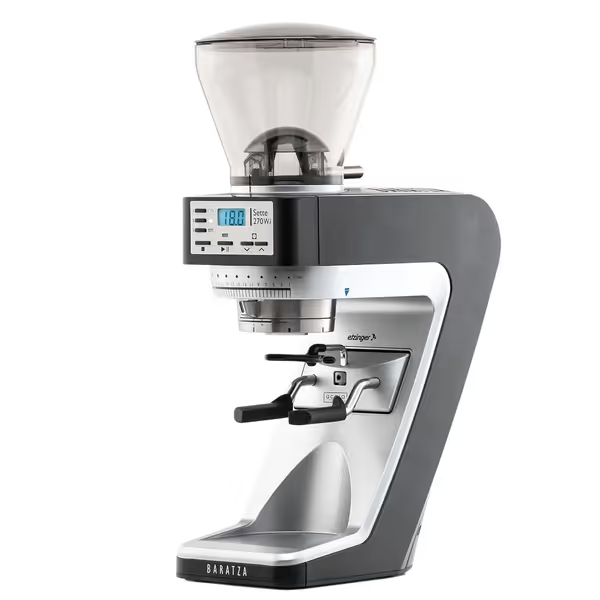
Baratza Sette 270Wi Grinder
Precision grind-by-weight for consistent espresso shots every time.
$599.95
Grind Settings270 (Macro/Micro)
Grind Settings270 (Macro/Micro)
Pros
Integrated Acaia grind-by-weight technology for accuracy
Fast 5g/second grinding with minimal retention
Exceptional espresso quality and fine adjustments
Cons
Variable noise levels reported by users
Customers praise the grinder's accuracy with its built-in scale and precise dosing capabilities, while also appreciating its high-quality espresso performance, fast grinding speed, and consistent results. Moreover, they find it easy to use and dial in, with one customer noting it fills portafilters perfectly without spilling.
Customers praise the grinder's accuracy with its built-in scale and precise dosing capabilities, while also appreciating its high-quality espresso performance, fast grinding speed, and consistent results. Moreover, they find it easy to use and dial in, with one customer noting it fills portafilters perfectly without spilling.
Q: How does scale choice impact workflow optimization?
A: It's about preserving focus where it counts.
Your brewing rhythm gets disrupted by context switching. Every time you shift attention between grinder, scale, and kettle, you risk:
- Over-pouring during bloom
- Missing extraction windows
- Spilling precious grounds
An integrated system (like the Baratza Sette 270Wi) solves this with workflow optimization through automation:
- Tare happens instantly when you clip on a portafilter
- Grinder stops at your exact dose (e.g., 18.3g for espresso)
- Built-in timer starts automatically on first water drop
This creates flow state for technique refinement. For the bigger workflow picture, compare single-dose vs hopper grinders to see how dosing style affects speed, retention, and freshness. Meanwhile, a separate scale demands deliberate steps:
- Grind into bin → transfer to portafilter → tare scale → start timer → pour
The trade-off: Integrated scales save 8-12 seconds per brew (critical for morning routines), but lock you into one grinder. Separate scales offer flexibility but require ritual discipline. If convenience is your priority, explore our best automatic grinders that pair well with integrated-scale workflows.
Q: Can a separate scale deliver "espresso-level" precision?
A: Absolutely, if you leverage its strengths.
Dedicated scales like the Maestri House S1 G Mini excel at precision coffee measurement through features standalone devices do better:
- Faster response times (0.2s vs 0.8s on some integrated models)
- Water resistance (vital for pour-over splashes)
- Advanced timing modes (e.g., flow-rate tracking)
Where they shine: method calibration. Want to dial in a new Kenyan pour-over? Use the Maestri's dual-zone timer to track both bloom saturation and total extraction. Its rechargeable battery (90-day life) and 0.1g precision handle everything from 15g espresso doses to 600g Chemex batches.
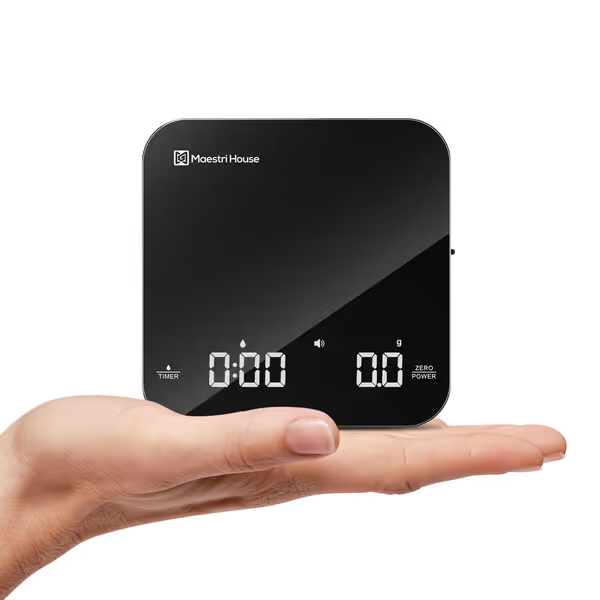
Rechargeable Mini Coffee Scale with Timer
Precise, compact, and rechargeable for perfect espresso and pour-over every time.
$31.99
Accuracy0.1g
Accuracy0.1g
Pros
Ultra-compact; fits most espresso machines.
0.1g precision for perfect extraction.
Dual timing modes and long-lasting rechargeable battery.
Cons
2000g limit may be too small for some non-coffee uses.
Customers find this coffee scale to be the best they've used, appreciating its perfect size for beans and espresso dosing, and its ease of use with espresso and coffee cups. They praise its accuracy, with one customer noting its 0.1 gram precision, and its convenient timer feature that works like magic. Customers consider it essential for espresso enthusiasts, with one mentioning it's perfect for dialing in pour-over and espresso recipes.
Customers find this coffee scale to be the best they've used, appreciating its perfect size for beans and espresso dosing, and its ease of use with espresso and coffee cups. They praise its accuracy, with one customer noting its 0.1 gram precision, and its convenient timer feature that works like magic. Customers consider it essential for espresso enthusiasts, with one mentioning it's perfect for dialing in pour-over and espresso recipes.
But beware the hidden cost: cognitive load. Tracking two devices fragments attention during critical phases. My advice? If you're mastering one method, go integrated. If experimenting across brew styles, a separate scale supports scale integration value through adaptability.
Q: What's the real longevity difference?
A: It's about repairability, not just specs.
Integrated scales tempt with "all-in-one" convenience, but consider:
- If the scale fails, you replace the entire grinder (cost: $300-$800)
- Standalone scales cost $25-$100 and live independently of grinder upgrades
Yet integrated systems win on calibration stability. Baratza's tech team confirmed their scale modules maintain 0.1g accuracy 3× longer than budget standalone options because they're factory-calibrated as a unified system.
Practical tip: For a "buy once" mindset, prioritize integrated scales if you'll stick with one grinder long-term. Choose separate scales if you anticipate upgrading grinders (e.g., stepping from Sette 270 to Forte AP).
Q: How do I decide without overcomplicating?
A: Match tools to your micro-goals.
Forget "best overall." Focus on your pain points:
| Your Brewing Reality | Recommended Path | Why It Fits |
|---|---|---|
| Espresso daily; tiny counter space | Integrated scale | Eliminates transfer mess; tare happens during grinding |
| Multi-method explorer (espresso + pour-over) | Separate scale | One device for all brews; no re-dialing when switching |
| Noise-sensitive home | Separate scale | Standalone scales lack grinder vibration interference |
| Data-driven learner | Separate scale with flow-rate mode | Visual feedback accelerates technique mastery |
This is where the method-first fit philosophy pays off. Your cousin's taped card worked because it reduced variables, not added gadgets. The right tool removes friction from your specific journey.
The Verdict: It's About Your Ritual, Not the Specs
Let's be clear: neither integrated nor separate scales are objectively superior. But scale integration value crystallizes when you consider your workflow:
- Integrated scales win for espresso-focused brewers craving speed and zero-transfer efficiency. They're ideal if you've dialed in your grind and want to preserve that sweet spot through automation.
- Separate scales win for method-hopping explorers who value adaptability. They future-proof your setup against grinder upgrades and support deeper sensory calibration.
Remember my core belief: simple, controlled changes teach you faster than complex tweaks. The "best" scale is the one that disappears into your ritual, freeing mental space for what matters, tasting the subtle shifts in your coffee.
Change one variable, taste twice, write it down. That's the real path to clarity.
Your Actionable Next Step
Test both approaches within 48 hours, no new gear required.
- Tomorrow morning: Use your current setup, but add one scale-based micro-goal. Example:
- Weigh only your coffee dose (ignore water)
- Note how ±0.5g changes flavor
- Day two: Borrow a friend's standalone scale (or use kitchen scales). Try:
- Taring after grinding (mimicking integrated workflow)
- Timing your bloom phase precisely
Compare notes. Did eliminating transfer reduce errors? Did manual timing deepen your understanding? This isn't about gear, it's about revealing your friction points. Next, fine-tune your grinder with our step-by-step guide to dialing in without wasting beans.
Once you identify where precision matters to you, the choice between integrated scale vs separate scale becomes obvious. And if you're still stuck? I'm always tweaking methods at community demos, find me where the grinder settings meet the tasting spoons.
Related Articles