Grinder Motor Torque Explained: Bean Density & Consistency
By Ravi Kulkarni • 12th Apr
Grinder motor torque isn't a glamorous topic, but it sits at the center of every shot and brew that reaches your cup. The real question isn't whether torque matters (it does), but how to translate torque measurements into the actual consistency and flavor clarity you taste. Understanding torque's impact on extraction means shedding marketing language and grounding claims in what motors actually do: maintain rotation under load, preserve thermal stability, and govern particle distribution uniformity.
Over the years, testing across espresso, V60, and French press setups, I've logged dial settings, retention grams, and decibel readings at counter height. Midway through one month-long comparison, a motor spiked variance in consistency after heat soak (a pattern invisible on spec sheets but glaring in the grind distribution data). That's when it became clear: the spreadsheet doesn't care about design aesthetics. Motor behavior either delivers repeatable grinds or it doesn't.
What Is Motor Torque, and Why Does It Matter for Coffee Grinding?
Understanding Torque as a Measure of Rotational Force
Motor torque is the rotational force the motor applies to the burr or blade, measured in Newton-meters (Nm) or foot-pounds (lb-ft). In practical terms, higher torque means the motor maintains consistent burr rotation even when resistance increases (such as when you dial finer or grind denser beans).
Torque becomes critical when the motor faces load. Think of two scenarios: grinding a light, fluffy African bean at a coarse setting versus grinding a dense, oily Brazilian at espresso fineness. The second scenario creates much higher resistance. A motor with insufficient torque will slow down, stall, or labor audibly. A motor with adequate torque will maintain its RPM, preserving the grind pattern you've dialed in.
What often gets lost in grinder spec sheets is the distinction between peak torque and continuous torque. Peak torque is the maximum force the motor can briefly produce (useful for breaking free when the burrs jam). Continuous torque is what the motor reliably supplies over normal operation. For home grinders, continuous torque is what shapes your day-to-day consistency.
The Relationship Between Torque and Motor Speed
Torque and speed (measured in RPM) aren't independent variables, they interact to determine performance. A faster motor (e.g., 15,000 RPM) with lower torque might grind quickly but generate excessive heat and fines. A slower motor with high torque can move the burrs steadily, reducing friction and thermal stress on the beans.
The practical sweet spot depends on burr geometry. Flat burrs require faster rotation to throw grounds outward, while conical burrs operate effectively at slower speeds. This means an espresso flat-burr grinder needs both speed and the torque to maintain that speed under fine-grinding load; a conical grinder might achieve consistency at 5,000 to 8,000 RPM with appropriate torque. For a deeper comparison of noise, retention, and use cases, see our conical vs flat burrs test.
How Does Torque Impact Bean Density and Grinding Resistance?
Bean Density as a Load Variable
Torque requirements shift with bean density and the coffee's physical composition. Hard, dense beans (common in high-altitude origins) resist the burrs more than soft beans. When you grind a dense bean, the motor must push harder to break it down, the mechanical resistance increases.
Without sufficient torque, the motor compensates by slowing down. Lower RPM during the grind means:
- Fewer cutting/shearing events per unit time
- Increased particle size scatter (more coarse outliers, fewer desired mid-range particles)
- Longer grind time, prolonging heat exposure
- Higher variance in grind distribution across the whole batch
This is why testing protocols standardize bean type and density. If you're measuring particle distribution, you want motor behavior isolated from bean variables.
How Higher Torque Prevents Stalling and Overheating
When a motor lacks torque, it stalls or throttles. Stalling means the burrs stop or jerk (chaotic, hard on the motor, and inconsistent for the grind). Throttling occurs when the motor reduces speed to pull sufficient current, it runs hotter and longer to complete the grind.
Heat management through torque becomes especially critical in espresso workflows. Espresso demands fine settings (often 2 to 4 mm burr gap). At fine settings, resistance is highest. A motor with insufficient torque will labor, heating the beans, the burrs, and the motor housing itself. High-torque motors, paired with moderate RPM, minimize friction and heat buildup.
Beans scorched by motor heat lose subtle aromatics and can taste flat or burnt. The damage isn't always obvious (not every bean manifests visible browning). Subtle flavor muting often gets attributed to water or technique when the real culprit was motor thermal stress during grinding.
What's the Connection Between Torque and Grind Consistency?
Torque Stability Drives Particle Distribution Uniformity
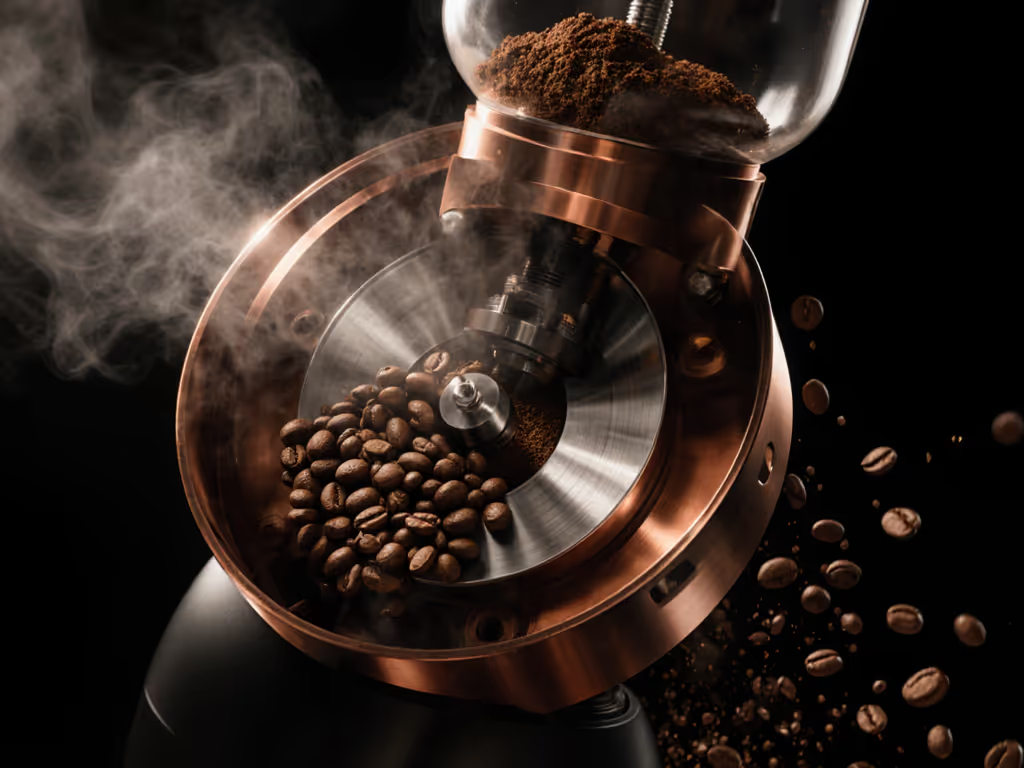
The relationship between torque and grind consistency is where measurements meet cup quality. When motor torque is stable and adequate, burr speed stays constant. Constant speed means predictable particle-breaking intervals and uniform distribution across the batch.
Variance and outliers creep in when torque drops mid-grind. You'll see a secondary population of over-fine particles (the motor stalled slightly, the burrs compressed harder at that moment) mixed with coarser material. In espresso, fines cause channeling and bitter taste. In pour-over, they cloud clarity and add astringency.
Let's anchor flavor claims to repeatable tests, not vibes. When I've tested the same grinder at two different ambient temperatures (cold morning versus heat-soaked afternoon), the afternoon grind shows more variance and outliers when the motor has already warmed. A motor with adequate continuous torque maintains speed stability despite thermal drift; a marginal motor doesn't.
How Grind Range Depends on Torque
Grinder motor efficiency at different settings is torque-dependent. A grinder rated for espresso-to-French-press range (roughly 0.5 mm to 1.5 mm burr gap) must handle vastly different resistance levels. Dialing coarse is easy (low resistance, minimal torque needed). Dialing fine, especially for espresso, demands high torque on demand.
This is why many single-dose or manual grinders fail at espresso fineness: they lack the motor torque to overcome the resistance at sub-1 mm gaps. They either stall, run slowly (introducing variance), or overheat. If a grinder spec doesn't explicitly state torque (only wattage or RPM), assume it's a generalist tool that won't excel at extremes.
FAQ: Critical Questions on Torque, Heat, and Grind Quality
Q: If a Grinder Has High RPM, Doesn't That Mean High Torque?
No. RPM and torque are independent. A high-speed motor (20,000 RPM) can have low torque, meaning it spins fast under no load but slows significantly under resistance. A high-torque motor (20 Nm) can run at moderate speed (8,000 RPM) and still maintain that torque even as resistance increases.
For home grinders, a moderate-RPM, high-torque design often outperforms a high-RPM, low-torque design. The former preserves speed stability and minimizes heat; the latter often throttles and loses consistency under fine-grinding load.
Q: How Do Flat and Conical Burrs Differ in Torque Demands?
Flat burrs require higher speed (often 10,000 to 15,000 RPM) to throw grounds outward effectively. This necessitates a motor that can sustain that speed even when fine-grinding resistance increases. Conical burrs operate at lower speeds (5,000 to 8,000 RPM) and, with proper geometry, achieve fine grinds with lower speed demand, though they still require adequate torque to maintain that lower speed under load.
Neither is superior; they're trade-offs. Flats can achieve narrower distributions (less variance and outliers) at the cost of higher speed, heat, and noise. Conicals often run cooler but may show slightly broader distributions if burr alignment is off or if torque is inadequate to hold the lower speed steady.
Q: Can I Tell if My Grinder's Motor Has Enough Torque?
Tests should measure:
- Grind time stability: Does the same beans at the same dial setting take consistent time across multiple runs?
- Burr speed hold: Does the motor RPM drop noticeably when dialing fine?
- Temperature rise: Does the motor housing or burr area heat significantly after 30 to 60 grinding sessions?
- Particle distribution spread: Are there unexpected outliers (very fine or very coarse) that weren't there before, suggesting motor slowdown mid-grind?
If any of these show degradation (longer times, bigger speed drops, more heat, broader distributions), inadequate torque is a candidate culprit. But without controlled testing, it's hard to isolate torque from other factors (burr wear, alignment, bean variability, ambient temperature).
Q: Does More Torque Mean the Grinder Is More Durable?
Higher torque doesn't automatically mean longer life. A high-torque motor running at lower speeds generates less heat and mechanical stress, potentially lasting longer than a low-torque motor laboring at high speed. But a cheap high-torque motor with poor bearings or a weak gearbox will fail quickly regardless.
Durability depends on motor quality, cooling design, duty cycle, and maintenance. A well-engineered mid-range motor often outlasts a cheap high-torque motor or a premium motor run continuously beyond its thermal limit.
Translating Torque into Brew Outcomes
High torque with moderate speed minimizes friction and overheating, directly supporting repeatable grind distribution. This matters because consistency in particle size (especially at the espresso fineness end) shapes shot flow, channeling risk, and taste balance. For pour-over, consistent coarse grinds mean fewer fines, clearer extraction, and brighter flavor. For method-specific targets and visuals, see our master grind size by brewing method guide.
When torque is inadequate, variance and outliers proliferate. The spreadsheet reveals the pattern clearly: scatter plots of particle size widen, shot-to-shot variance increases, and flavor becomes harder to dial in.
Further Exploration
Motor torque is one pillar of grinder performance. To deepen your understanding:
- Compare motors within your target price range using continuous torque specs (not peak), and cross-reference with user reports of grind time consistency and thermal behavior.
- Establish a measurement baseline for any grinder you consider: measure grind time at a fixed dial setting for 5–10 runs, record burr-area temperature, and inspect particle distribution. These tests are simple but rarely published, doing them yourself reveals how torque translates to your brew method.
- Test before committing: If possible, try the grinder with beans you know well. Dial in espresso or filter at your usual speed and note repeatability. One shot or brew is anecdotal; three repeated attempts reveal motor stability.
- Consider your workflow: If you grind for espresso one day and pour-over the next, you need a motor that maintains stable torque across a wide range of dial settings. Specialty grinders optimized for one method often lose consistency outside their narrow torque sweet spot.
Torque isn't glamorous, but it's foundational. Let measurements guide you, not marketing claims.
Related Articles