
Burr Alignment Troubleshooting: Restore Consistent Extraction
By Ravi Kulkarni • 2nd May
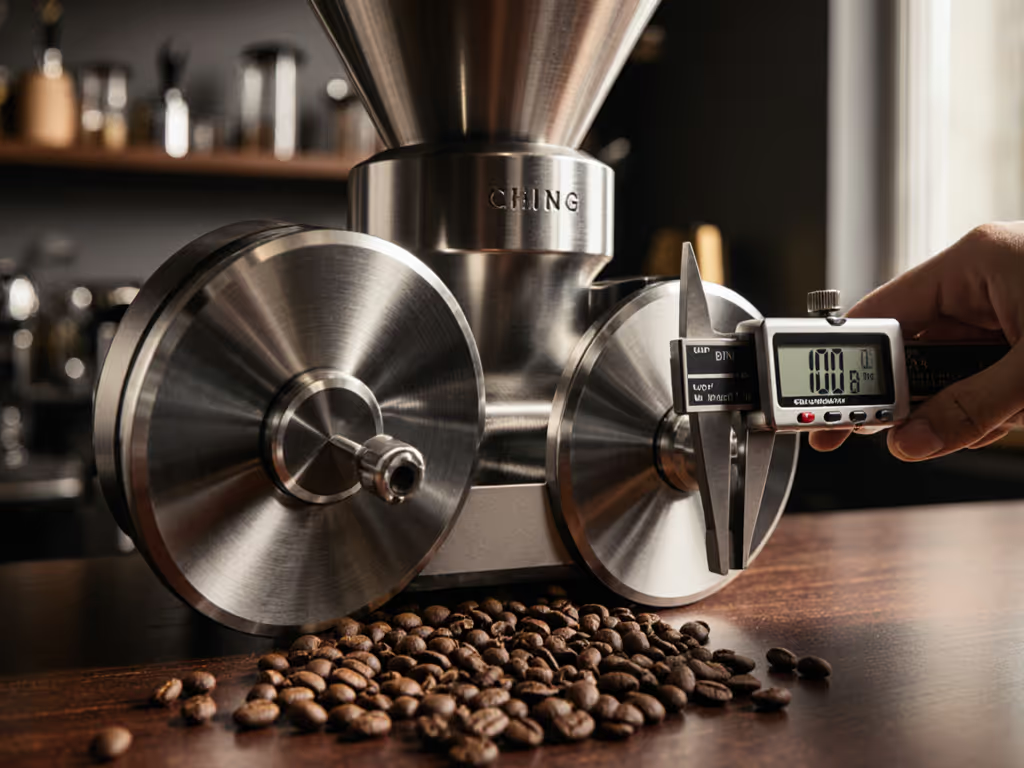
Uneven extraction stems from misaligned burrs more often than from bean quality or water temperature. Grinder burr alignment troubleshooting isn't mystique. It is a diagnostic workflow. When your espresso pulls thin or your V60 muddles with fines while your neighbor's identical grinder produces clarity, the culprit often sits between your burrs. Measuring that gap, identifying drift, and correcting it through repeatable protocol turns guesswork into actionable repair.
Why Alignment Dictates Your Measured Cup Outcomes
Burr alignment affects particle distribution at every grind size, but most reviewers skip this foundation. When burrs sit parallel and equally spaced, grind force distributes evenly, yielding a symmetric distribution curve. When they drift (one side closer than the other, or both tilted during rotation), pressure concentrates on high points, creating lumps and fines while starving the mid-range. The spreadsheet tells the story: a 0.05 mm drift can shift your fines population by 3-5 percentage points, enough to flip a pour-over from clean to sluggish or push espresso from sweet to astringent.
Most of us trust feel and taste, which is why misalignment hides for months. A grinder can seem quiet and responsive while systematically under-grinding one zone. Only when you log dial position, dose, extraction time, and tasting notes (then plot them) does the pattern emerge. That's not obsessive; it's the same logic a technician uses to validate a burr assembly before shipping.
Alignment Indicators: What to Measure
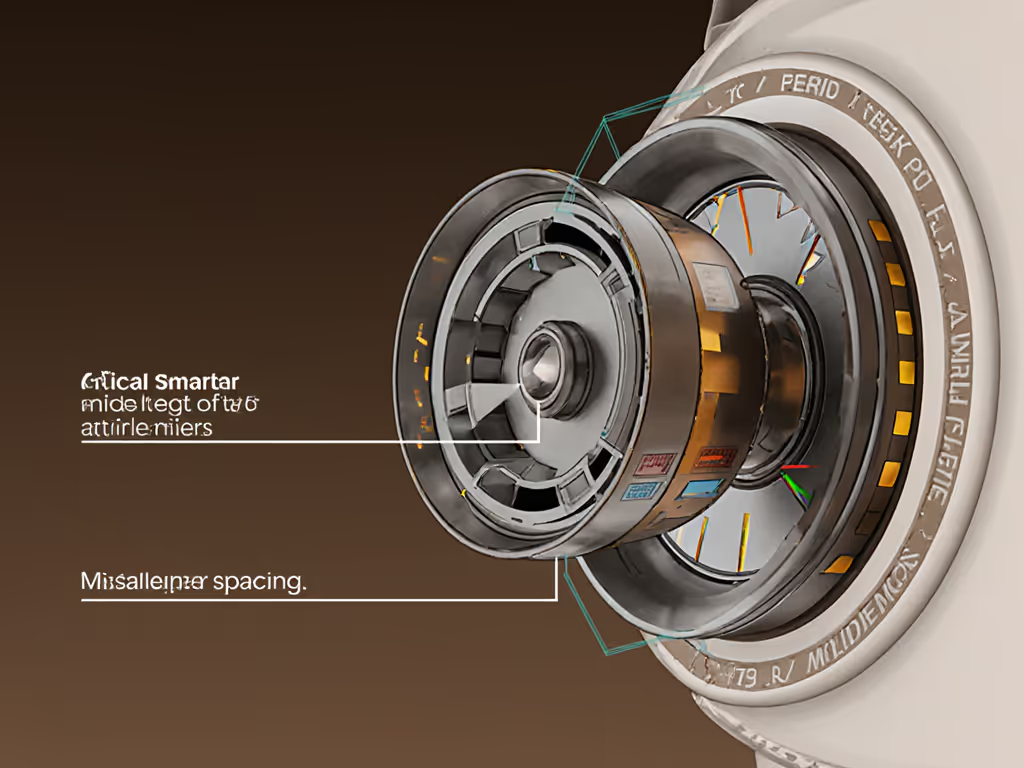
Three variables reveal alignment status without disassembly:
1. Burr Runout Under Load Rotate the grinder empty (no beans) and listen for cyclic grinding sounds at slow speed. A rhythmic scrape or chirp suggests one burr dips lower during each rotation. The converse (uniform silence) suggests concentric burrs. This is your first red flag, not your diagnosis.
2. Retention by Grind Size Weigh residual grounds in the throat after grinding 10 g of beans at three settings: coarse (pour-over), medium (Chemex), fine (espresso). Log the mass. For background on why retention matters and how to reduce it, see our grinder retention guide. Unaligned burrs trap fines in low-pressure zones, inflating retention by 0.2–0.4 g at fine settings while coarse retention stays normal. Compare your baseline (from your manual or a known unit) to your current grinder. Deviation >0.3 g at fine settings warrants investigation.
3. Particle Size Variance Across Brew Methods Brew two identical V60 cups: one with grind size "A" (your baseline dial), one at "A-2" (two clicks coarser). If the A-2 cup tastes significantly less bitter but also thinner or slower-draining than expected, misalignment likely skews your fine end upward at standard settings. A well-aligned grinder shows smooth taste progression; a misaligned one jumps.
Flat Versus Conical Burrs: Where Alignment Diverges
Comparative testing reveals that flat and conical burrs fail differently under misalignment (a distinction most guides ignore).
Flat-burr grinders (Baratza Sette, Mignon Notte) sit burr-to-burr horizontally. Misalignment tips one or both burrs, shrinking the gap on one edge while opening it on the other. This creates a radial gradient in particle size: the tight side grinds finer, the loose side coarser, within a single grind cycle. Espresso pulls show blonding and sourness (under-extracted in loose zones) alternating with bitter pockets (over-extracted in tight zones). During a month tracking dial-in variance across V60 and espresso with flat-burr units, one grinder's quiet operation masked a 2-3 mm burr wobble after heat soak (discovered only when I cross-referenced my retention logs against ambient temperature). The scatterplot didn't care about subjective "feeling balanced"; it showed drift.
Conical-burr grinders (Wilfa Svart, Fellow Ode, Niche Zero) nest one burr inside the other vertically. A conical misalignment typically tilts the inner cone off-axis, causing uneven grinding in spiral arcs rather than radial zones. The particle distribution skews differently: more fines accumulate overall (since the inner burr scrapes unevenly), but they distribute chaotically rather than in zones. Espresso tends to choke or channel. You'll dial in, pull a beautiful shot, then the next grind clogs the portafilter. Dialing-in speed plummets because consistency vanishes.
The practical difference: flat-burr misalignment is often visible (wobble under load, audible scrape) and sometimes correctable by shim adjustment. Conical misalignment is silent and usually requires burr re-seating or replacement.
Calibration Techniques: Protocol-Based Adjustment
Before adjusting, document your baseline. Set your grinder to your standard espresso dial (e.g., dial position 40 on a 1-100 scale), grind 20 g, weigh retention, and record it. Do this twice on different days. This is your Protocol ID: Baseline-Retention-A.
Now, identify misalignment candidate:
- If retention variance >0.4 g day-to-day at fixed dial position: suspect thermal drift or burr wobble. Let the grinder cool for 30 minutes and repeat. If variance shrinks, thermal expansion is involved; if it persists, alignment is suspect.
- If one brew method consistently pulls slower or faster than the other: grind a consistent 18 g dose on your espresso dial, measure actual shot time and taste, then grind the same dial on your filter setup. If espresso runs fast but filter runs slow (or vice versa), uneven burrs are starving different zones.
For Flat-Burr Grinders: Many models include shim slots or burr-height screws. Consult your manual for the adjustment procedure (do not guess). Typically: loosen the top burr carrier slightly, insert a calibrated shim (0.05-0.10 mm), tighten, and re-test retention at fixed dial. Change only one variable per trial. Log each attempt with dial position, dose, and retention mass. Adjust in 0.05 mm steps. Need help choosing an adjustment system? See our stepped vs stepless comparison. Most misalignments correct within 2-3 iterations.
For Conical-Burr Grinders: Shim adjustment is rarely available. The fix is re-seating: fully disassemble the burr carrier (following your manual), inspect for debris or scratches, clean with a dry brush, and reassemble with snug-but-not-forced pressure. Many conical misalignments trace to debris lodged between burr and seat, creating a false offset. After reassembly, repeat your Baseline-Retention-A protocol. If retention normalizes, debris was the culprit. If it persists, the inner burr may be damaged; consult the manufacturer.
Particle Distribution Impact: Linking Metrics to Extraction
Misaligned burrs widen your distribution curve: more fines, more oversized particles, fewer in the optimal mid-range. Here is how that maps to cup:
- Espresso: fines clog the puck, prolonging pre-infusion and early saturation, then sharp channeling through voids. You taste sour, weak body, and fast shots despite dialing fine. Coarse oversized particles underextract, leaving earthy, thin cups.
- Pour-over: fines slow drainage and muddy clarity; oversized particles race through, under-extracting, leaving sour notes and dry body. The pour feels uncontrolled (slow-fast-slow rather than smooth).
- French press: fines and oversized particles both settle to the bottom, clogging your cup. You taste gritty, bitter sediment with thin top notes.
A particle distribution measurement (via laser diffraction or imaging, if you have access) shows this quantitatively. Most home grinders show a unimodal (single-peak) distribution when aligned, with ~10-15% fines and ~10-20% oversized at espresso settings. Misaligned units flatten that curve: fines spike to 18-22%, oversized drift toward 25-30%, and your mid-range compresses. You won't perceive that as a technical graph; you'll perceive it as "inconsistent," "needs dialing every day," or "tastes muddy."
Troubleshooting Framework: Systematic Diagnosis
When extraction fails despite dialing changes:
Step 1: Establish Your Baseline Grind a consistent dose at your standard setting three times over three days. Weigh retention each time. If variance <0.2 g and taste is stable, alignment is likely sound. If variance >0.4 g or taste lurches between cups, proceed.
Step 2: Thermal Stability Test Grind continuously for 60 seconds (heat the burrs), let cool 30 minutes, then grind again at the same dial. Log retention. Spike indicates thermal drift; persistent shift indicates alignment drift.
Step 3: Visual and Tactile Inspection With the grinder unplugged, rotate the burr carrier by hand (if accessible) and listen for grinding sounds or feel for resistance variance. Smooth rotation suggests alignment; scratching or grinding sounds signal concern.
Step 4: Comparative Brew Test Brew espresso, V60, and French press at your standard dial, all with the same bean lot and dose. If one method tastes consistently sour or bitter while others improve with dialing, misalignment likely skews your distribution in a way that harms one method more.
Step 5: Adjustment or Escalation If Steps 1-4 confirm misalignment, apply your grinder's adjustment protocol (shim or re-seat). If no improvement after two attempts, contact the manufacturer (burr damage may require replacement).
Moving Forward: Further Testing and Refinement
Alignment is a foundation, not a fix-all. Once burrs sit true, your dialing-in becomes predictable, your variance shrinks, and your measured cup outcomes stabilize. Let's anchor flavor claims to repeatable tests, not vibes. That discipline catches real problems and saves beans, time, and frustration.
If you've logged retention and taste across dial positions and the pattern shifts unexpectedly, return to this framework. A grinder that grinds well for three months, then drifts, is teaching you something about wear, thermal stress, or assembly. Understand the long-term effects in our explainer on burr wear and extraction stability. Document it. The next troubleshoot will be faster, and your next grinder purchase will be wiser.
Related Articles